Implantable Hardware Development (IHD) involves designing, engineering, and transferring to manufacturing the devices that are surgically placed inside the body to monitor physiological functions, deliver therapy, or restore lost capabilities. The scope is broad, and the work involved is highly specialized. Each component must function reliably inside the human body, under continuous mechanical and biochemical stress, often for years.
Development Lifecycle
The development lifecycle begins with an idea and progresses through concept development, prototyping, and design verification and validation testing. Verification confirms that a device meets its design specifications, and validation confirms that it performs as intended under real-world or simulated-use conditions. From there, devices move through design transfer to manufacturing, regulatory review, and, once cleared, ongoing post-market surveillance. Short-term implantable devices, long-term devices, and next-generation systems all follow this same general path, but with different requirements at every stage: a long-term implant, for example, faces more extensive biocompatibility and fatigue testing than a short-term device, while next-generation systems typically require more design iteration before reaching a stable, verified design. Design for manufacturability is considered from the earliest concept stage, not addressed only once a design is finalized.
Core Requirements
Biocompatibility, (bio)mechanical stability, and electrical functionality form the baseline. These requirements extend further: the device must maintain long-term stability despite continuous mechanical and biochemical stress, resist body fluids over its intended lifetime, achieve hermetic sealing where needed, and be sterilizable before implantation. These requirements interact. A decision made regarding sealing affects material selection, which in turn affects biocompatibility and what can be tested and documented.
Samples and Studies
Components and fully implantable devices are developed for every stage of a program. This includes samples for animal and human studies, such as first-in-human and chronic implantations, as well as samples for verification and validation testing. Miniaturized samples are designed and manufactured specifically for systemic toxicity assessments and other biological and toxicological risk evaluations. The sample type and its manufacturing process must match what the final device will use, so that study results are representative of the final device.
Housing and Packaging
Placing electronics fully inside the body raises a direct engineering question: how can they be protected from the surrounding environment while remaining small enough for implantation? Housings are developed in different shapes, sizes, and materials, including ceramic and metal. Whether fully hermetic packaging is necessary depends on the device and its intended duration. Short-term implants carry different requirements than chronic systems, and the housing design must reflect that distinction.
Polymer Processing
Silicone is the most common material used for these processes, though other biocompatible polymers may be used depending on the application. In many designs, a fully assembled housing is encapsulated in a medical-grade polymer through overmolding. Overmolding serves multiple functions: it provides an additional barrier against body fluids, protects mechanical junctions from stress and micro-movement, and shapes the outer profile of the device for the intended implantation site. In other designs, the device itself is built primarily from the polymer, with electrodes, conductors, or other components embedded directly into the body rather than housed separately and then overmolded. In both cases, the polymer formulation, wall thickness, and process parameters are selected based on the device’s geometry, its target anatomy, and the required lifetime. Where transitions between rigid and flexible sections occur, polymer processing also manages the mechanical gradient, distributing strain rather than concentrating it at a single point.
Interconnects
The housing must connect to other components, including electrodes. Some of these connections are permanent, made through feedthroughs that route conductors through the housing wall in a sealed, fixed configuration. Others are designed to be detachable: implantable connectors that allow leads or electrodes to be mated and unmated in vivo, for example to support device replacement, staged implantation procedures, or modular system configurations. Implantable connectors, whether fixed or detachable, can accommodate different numbers of channels, depending on the application. Each junction between dissimilar materials, and each mating interface in a detachable connection, must be engineered to withstand the mechanical and biochemical conditions it will face over the device’s lifetime.
Cabling
The requirements for implantable cables vary depending on the implantation area and cable length. The central trade-off is rigidity versus flexibility, and the governing constraint is long-term stability under the body’s continuous (micro)-movement. High-channel cabling adds further complexity. Depending on the application, straight, twisted, stranded and coiled conductors, in different combined insulation options are used.
Electrodes and Tissue Interfaces
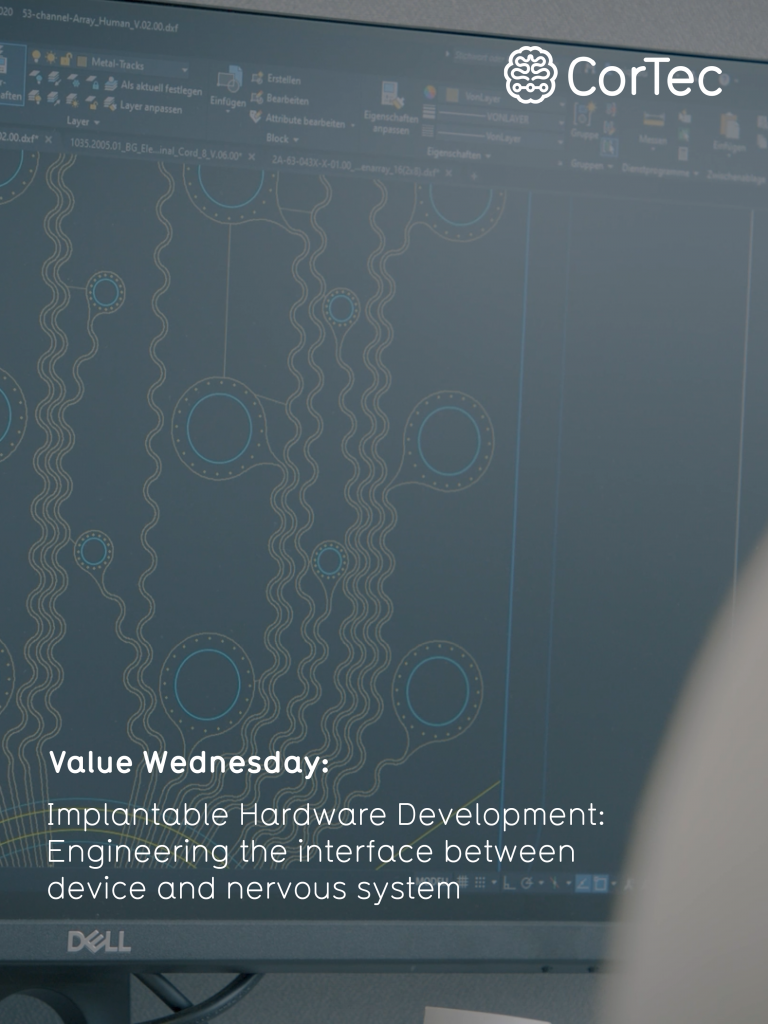
The electrode is where the device and nervous system meet. Applications across the peripheral nervous system, spinal cord, cortex, and other targets each require different electrode types, and every type has its own requirements based on function and target environment. Thickness, stiffness, spatial resolution, stability, flexibility, and resistance against body fluids all vary accordingly. The size of these interfaces varies just as widely, from single, larger-scale contacts to dense micro-scale arrays, and channel counts differ significantly by application, ranging from a small number of contacts to systems with far higher channel counts, depending on the resolution and selectivity required. There is no single electrode design that works across all applications.
Testing, Verification, and Documentation
Throughout all phases of the development process, documented evidence is provided to ultimately demonstrate that the device meets the specified requirements. This work includes environmental and mechanical testing, the characterization of electrochemical safety, and risk analyses. Both short-term and long-term aging tests are planned and conducted using test equipment developed specifically for the program, unless standard test setups are available.
How CorTec Supports Your IHD Project
A cross-functional team of project managers, design engineers, test engineers, material scientists, and mechanical and medical engineers carries out this work. Together, they guide customers through the entire process of developing a custom implantable device, from conception to manufacturing-ready hardware.
Project management support keeps the program on track at every stage. Technical consultation draws on years of experience across electrode design, housing and packaging, cabling, interconnects, and test development.
If you are developing an implantable device, we would like to hear about your project.