When developing an active implantable device, the electronic system is rarely the most visible part of the project. Yet it determines almost everything that matters: how long the device lasts, how small it can be, whether it will pass regulatory review, and ultimately whether it is safe to implant in a human body. Understanding these requirements early helps teams avoid the kind of costly detours that surface late in development.
Five engineering challenges sit at the center of this work: size and form factor, power architecture, wireless power and communication, regulatory requirements, and long-term reliability.
Size and Form Factor
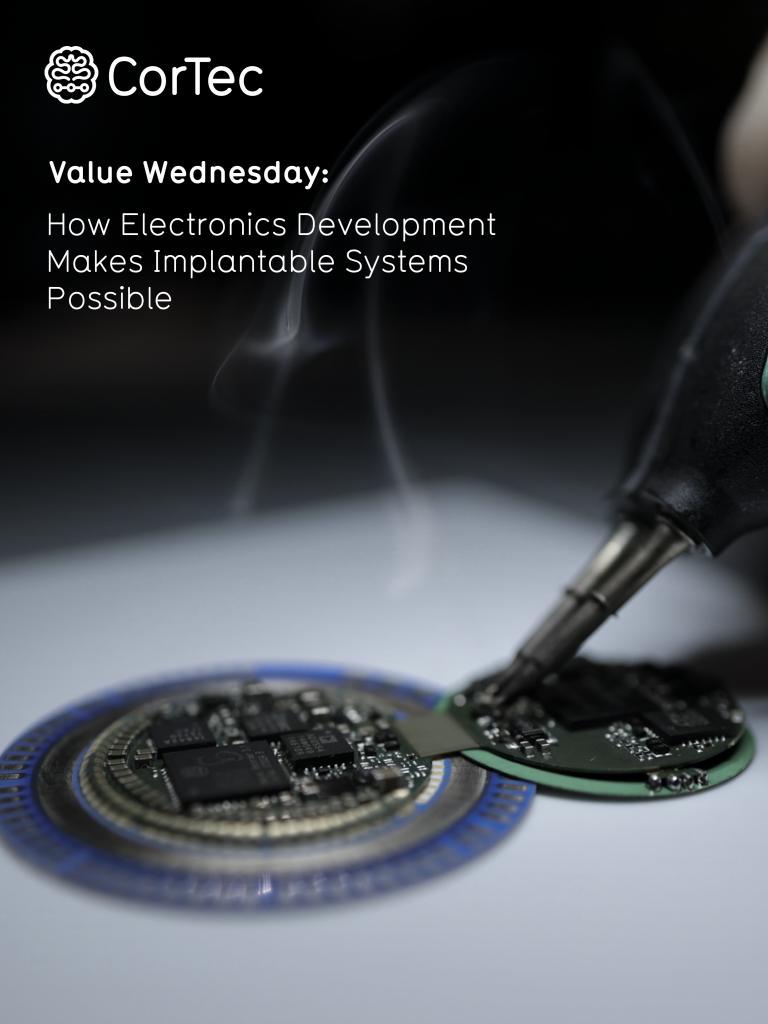
The body sets the boundaries, and the electronics have to fit within them. Every component, solder joint, and interconnect must be as compact as physically and electrically feasible. This drives component selection toward the smallest available packages, demands highly dense PCB layouts, and requires careful management of every cubic millimeter in the assembly. Rigid-flex PCBs have become the standard approach because they allow complex circuitry to follow anatomical geometries that rigid boards simply cannot accommodate, while keeping the overall assembly small enough for a safe implantation. Miniaturization also has a direct clinical dimension: a smaller implant means a less invasive procedure, faster recovery, and in many cases a broader patient population that can be treated.
Power Architecture
Because an implant cannot be plugged in, and surgical access for a battery replacement is a significant clinical event, the choice of power architecture is one of the most consequential decisions in the entire project.
Battery-free devices draw their energy externally via inductive coupling, which removes the risks associated with an internal energy storage device but requires the patient to wear and correctly position an external unit. Cochlear implants are the most established example of this approach, and they demonstrate how well the concept works when the patient’s daily routine can accommodate the external component.
Devices with a primary battery operate on a non-rechargeable cell for several years, and even a few microamperes of standby current will measurably shorten that lifetime.
Rechargeable batteries come into play when the application demands more sustained power than a primary cell can provide. Since the battery tends to be the largest single component in the implant, every microampere saved in the circuit translates directly into a smaller device and a less invasive surgical procedure.
Wireless Power and Communication
A chronic percutaneous connection for power or data is not a viable option, as it would create a persistent infection risk at the skin interface. All energy transfer and communication therefore happen wirelessly. Firmware updates are delivered over-the-air, with the security architecture needed to ensure that only authorized updates reach the device. For shipping and storage, a hibernation mode protects the battery so that the device arrives at the clinic in the condition it was intended to be used in.
Regulatory Requirements
Active implant development takes place within a defined regulatory framework, and that framework shapes engineering decisions from the very first design review. ISO 14971 risk management runs continuously alongside development: every identified hazard and every risk control measure must be traceable through the design history file. Achieving FDA approval for human use requires thorough documentation across the full development lifecycle. All suppliers of components and manufacturing services must guarantee med-tech quality. It is best to choose suppliers with ISO 13485 certification and to perform audits. The earlier these requirements are built into the project structure, the less disruptive they are to meet.
Long-Term Reliability
An active implant must function reliably for ten years or more, with no possibility of repair once it is in the body. This places particular demands on both material selection and manufacturing process control. Process temperatures during reflow soldering and sterilization can exceed 100°C, and every material in the assembly must tolerate this without degradation. PCBs, especially rigid flex, absorb moisture during production and storage, and any humidity sealed inside a hermetic enclosure will eventually migrate and cause failures, sometimes years after implantation. Controlled drying before encapsulation is therefore a defined process step, one that has a direct and measurable effect on the long-term reliability of the finished device.
How CorTec Supports Your Electronics Development
CorTec has built its development and manufacturing capabilities specifically around the demands of active implantable devices, accompanying projects from the first technical discussions through to the regulatory path.
Our electronics team handles rigid-flex PCB design as a routine part of the work, with layout and component selection optimized for the constraints of each specific application. Power architecture decisions are addressed early and in close collaboration with the client, because they influence every subsequent design and manufacturing choice. For wireless power and communication, we draw on established protocols and in-house experience to identify the right approach for each use case.
Risk management, according to ISO 14971, begins at the first design review and continues throughout development. Our quality management system is certified to ISO 13485, and we have guided multiple development programs through the documentation and testing requirements of FDA submissions.
If you are developing an active implantable device and want to understand how the electronic system fits into your project roadmap, we are glad to walk through it with you. Contact us