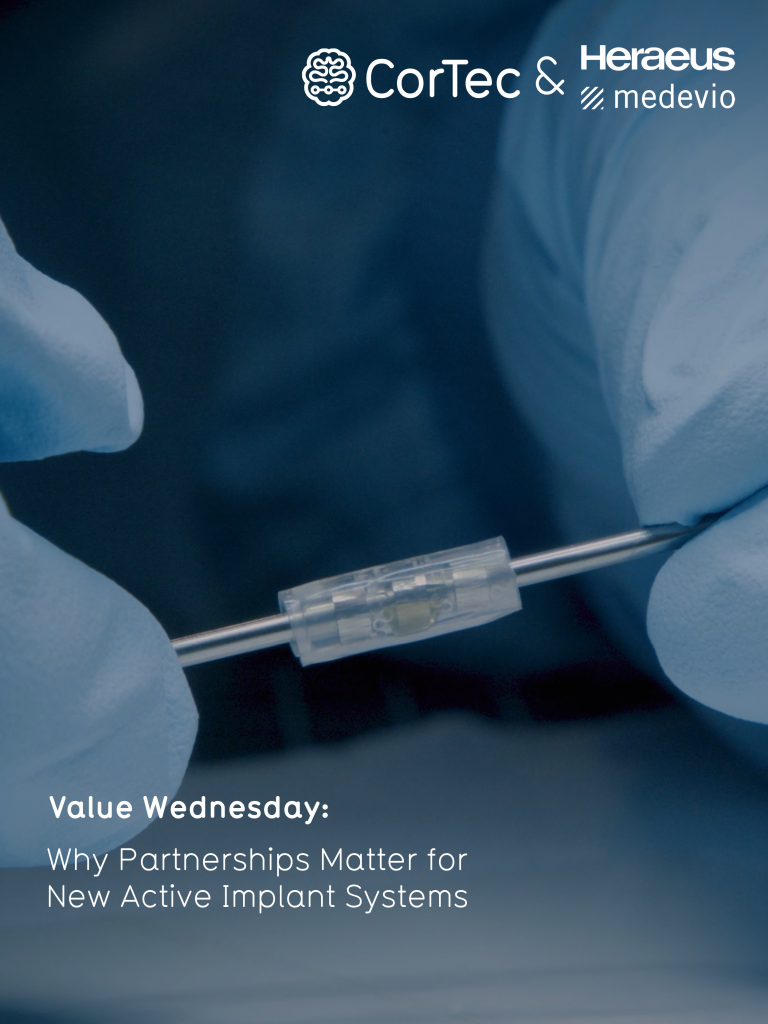
Building a new active implant system is one of the most complex undertakings in medical technology. The technical challenges are significant. The regulatory requirements are demanding. The timelines are long, the capital requirements substantial, and the margin for error narrow.
Most organizations entering this space underestimate one thing above all: how much of what they need already exists elsewhere, and how much faster they could move by accessing it.
The real cost of building everything in-house
The instinct to build internal capability is understandable. Control, ownership, and independence are real advantages. But in active implant development, the cost of that instinct is often invisible until it becomes unavoidable.
Cleanroom infrastructure takes years to establish and certify. Quality management systems must be built, documented, and audited before they can support a regulatory submission. Expertise in hermetic encapsulation, implantable electronics, and biocompatible materials is scarce and takes time to develop. Every month spent building this foundation is a month not spent advancing the core therapeutic concept.
For organizations working under funding pressure or competitive timelines, that is not an abstract risk. It is a strategic liability.
What the right partner actually provides
External partnerships in active implant development are not a compromise. They are a strategic decision. The right partner does not simply fill a capability gap. It changes the risk profile of the entire project.
Access to certified cleanroom facilities and established quality systems eliminates years of infrastructure development. Proven expertise in system integration, hermetic packaging, and regulatory documentation reduces the number of costly iterations required to reach a robust, scalable solution. A partner with an existing FDA masterfile does not just save time, but fundamentally changes what a regulatory submission looks like from day one.
The compounding effect is significant. Fewer iterations. Shorter timelines. More predictable outcomes. Lower burn rate at every stage of development.
Speed as a competitive advantage
In markets where multiple teams are pursuing similar therapeutic concepts, time-to-market is not just an operational metric, it is a competitive differentiator. The organization that reaches clinical trials first shapes the evidence base. The one that reaches market first defines the standard of care.
Strategic partnerships compress the development timeline at precisely the stages where delays are most expensive: prototype development, preclinical validation, and regulatory preparation. These are not stages where speed and quality trade off against each other. With the right partner, they reinforce each other.
The commercial case for alignment: Development, Scale-up and Manufacturing
Partnerships also change the commercial trajectory of a project. When development, industrialization, and manufacturing are aligned from the start, handovers between stages become smoother. Documentation is consistent. Processes are already validated. The path from clinical trial to commercial launch does not require rebuilding the supply chain from scratch.
For investors and boards evaluating active implant programs, this alignment is not a soft benefit. It is a measurable reduction in execution risk and a stronger foundation for the conversations that determines whether a program gets funded to completion.
This is why the CorTec + Heraeus Medevio model works.
CorTec handles development and advanced system integration, working with partners to refine concepts and validate core technologies. Heraeus Medevio brings manufacturing expertise and scale-up capabilities, ensuring that processes developed in the lab translate seamlessly into production. The result: no handoff surprises, no process redesign cycles, no manufacturing bottlenecks at the critical moment when you need speed.
Why CorTec
CorTec is built specifically for this kind of partnership. Our focus is active implantable technologies — not as one capability among many, but as the core of everything we do. We bring together design, materials, hermetic encapsulation, leads, and testing under one roof, with a quality system and cleanroom infrastructure already in place.
Our closed-loop platform, validated across up to 32 channels, backed by an FDA masterfile, and configurable for specific clinical applications, gives development teams a proven foundation rather than a blank page. Partners do not start from zero. They start from a system that has already been designed, tested, and documented to meet the demands of implantable device development.
For teams with ambitious active implant concepts and realistic timelines, that starting point is not a detail. It is the difference between a program that reaches patients and one that runs out of runway before it gets there.
Strategic Partnerships Across the Full Product Lifecycle
The most successful active implant programs are built on aligned partnerships that span from concept through commercialization.
CorTec’s deep expertise in development and system design combines with manufacturing and scale-up specialists like Heraeus Medevio to create a complete ecosystem. Whether your focus is proprietary electrode design, algorithmic innovation, or novel therapeutic approaches, you can concentrate your resources there. The rest, cleanroom infrastructure, hermetic integration, process scale-up, regulatory documentation, is handled by partners who have built their entire business around these challenges.
This model reduces execution risk at every stage. It accelerates development. And it dramatically improves the odds that your innovation actually makes it to patients.
The Takeaway
Building active implants is hard. It does not have to be done alone. The organizations winning in this space are not the ones trying to own every capability. They are the ones smart enough to focus on their core innovation and partnering strategically for everything else.
If you are developing an active implant system and want to talk about how partnerships can accelerate your path to clinic and commercialization, we’d like to help.
About Heraeus Medevio
Heraeus Medevio is a global medical device development and manufacturing partner dedicated to helping customers bring life-saving and life-changing technologies to market faster. Leveraging more than 170 years of materials science expertise from the Heraeus Group, Heraeus Medevio provides end-to-end support across product development, engineering, advanced materials technologies, industrialization, manufacturing, and commercialization. Serving medical device innovators worldwide, the company combines deep technical expertise, global resources, and a collaborative approach to solve complex challenges, accelerate growth, and improve patient outcomes.