Brain Interchange™
A two-way link to the brain.
Reading and responding, in near real time.
Closed-Loop Streaming BCI for Adaptive Neurotherapy
Brain Interchange senses neural activity and responds to it, opening a new path for therapeutic brain-computer interfaces.
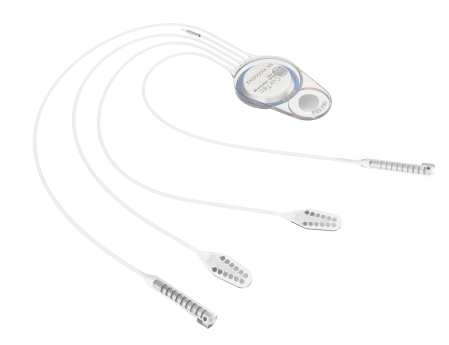
A fully implantable system for continuous neural data streaming, combining recording and stimulation with seamless wireless communication across all system components.
What it does

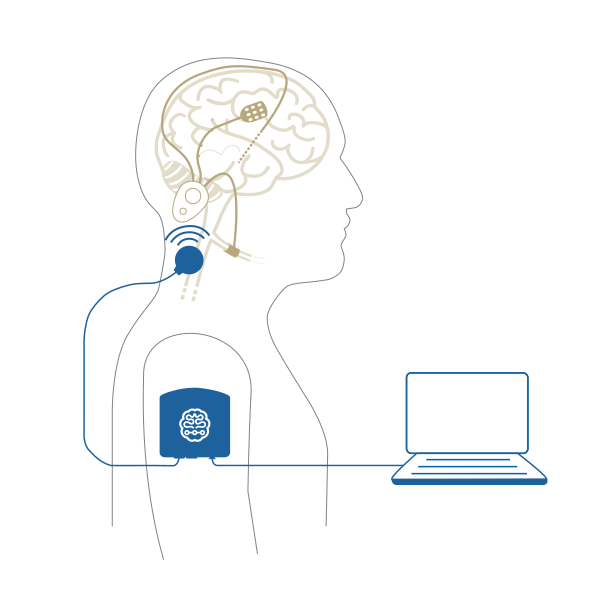
The Brain Interchange System enables bidirectional interconnection between the nervous system and external information technologies: it records neural signals through implanted electrodes and modulates the nervous system through electrical stimulation. The implanted electronics amplify and digitize the recorded signals and transmit them wirelessly through the skin to an external unit worn on the body. From there the data reaches a computer, where software interprets it and determines how to respond. Stimulation commands travel back to the implant, which delivers them to the target nervous system. Because the system both reads and writes, this exchange runs continuously and in near real time, so stimulation is informed by the target nervous system's own signals, allowing for adaptive neurotherapy.
Built for more than one target. Where a single-purpose BCI is designed for one site in the brain, Brain Interchange can be equipped with any lead type from our electrode portfolio, from paddle and percutaneous to cuff and depth electrodes, reaching whichever target an indication requires, all within one implant. Beyond the cortical arrays used in stroke, this opens the platform to a broad spectrum of neurological targets, and to partners developing their own adaptive neurotherapies.
How it works
Head Piece
Worn on the head above the implant, the Head Piece powers the implant wirelessly through the skin and exchanges data with it in both directions.
Interfaces
The electrodes that connect the implant to the nervous system. Depending on the application, these can be grid or paddle leads on the brain or cuff leads on a nerve, each engineered around the target.
Implant
The implanted unit sits in a recess in the skull, flush beneath the scalp. It records neural activity and delivers stimulation through the connected electrodes, reading from and writing to the nervous system.
External Unit
The External Unit supplies power to the Head Piece and connects it with the Computing Unit.
Computing Unit
Runs the software that processes the data, controls the implant and gives clinicians a user interface to set stimulation parameters and review system information.
Key specifications
32 recording and flexible choice of stimulation channels, each contact usable for both. Recording mode offers various gain settings (100x,180x, 360x, 750x) and neural signals are sampled at 1 kHz with 16-bit resolution/dynamic range, down to a smallest increment of 74 nV (in highest gain mode). Stimulation is current-controlled, and allows for bi- or monopolar stimulation using asymmetric, biphasic, charge-balanced pulses delivered through any of the 32 contacts, with amplitudes up to −6 mA (24 µA increments) and pulse widths from 10 to 2500 µs. The implant is battery-free, powered wirelessly through the skin by inductive coupling, and data travels in both directions over a 2.4 GHz radio link, with a closed-loop latency of 25 milliseconds or less.
Implantable Unit
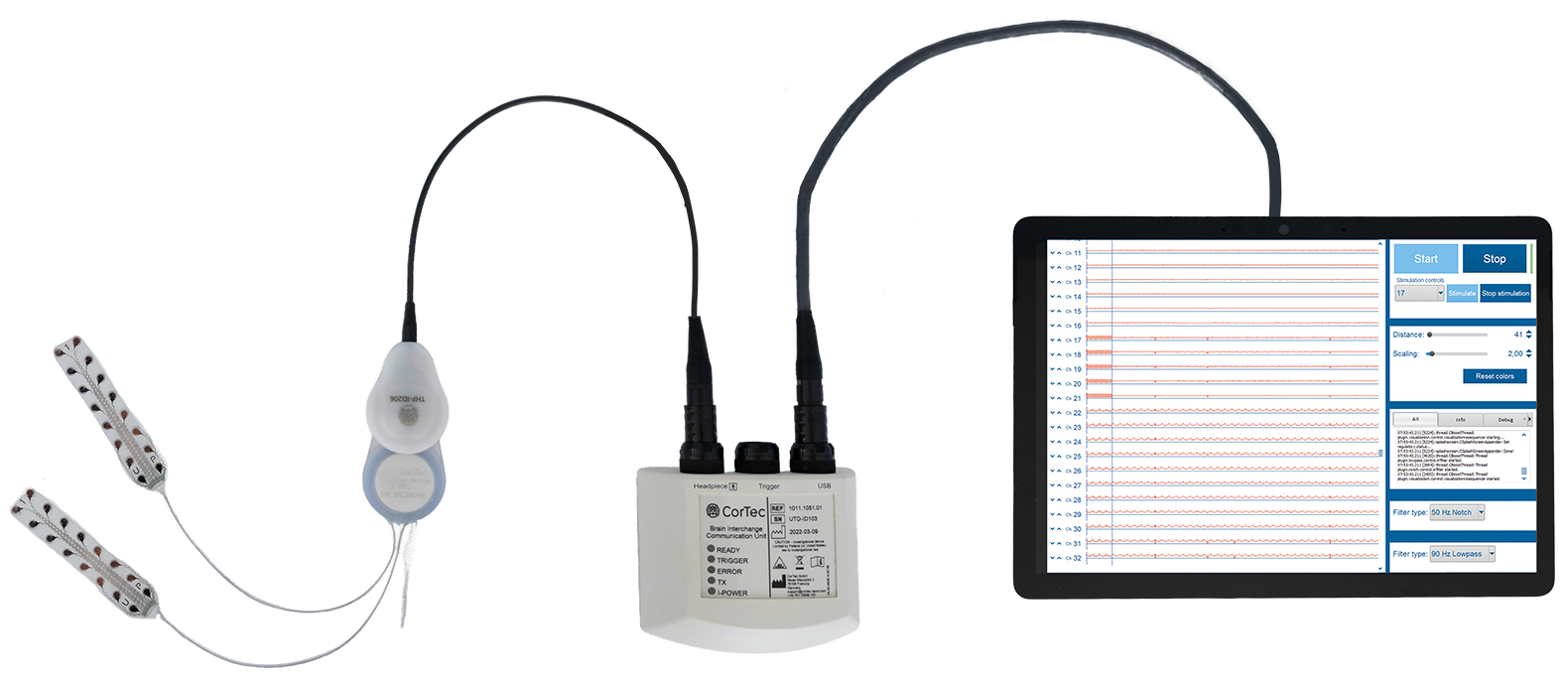
The Implant is comprised of the Implanted Electronics Unit and one or two ECoG electrodes plus one optional ground (GND) electrode contact.
External Unit
The External Unit consists of the Head Piece, which supplies power to the Implanted Unit, and the Communication Unit, responsible for secure wireless data exchange with the Implanted Unit.
Computing Unit
The Application Software provides users with a graphical user interface. The computer manages the telemetry (programming of stimulation parameters, accessing the system information, and data transmission) and analyses the data. Our CorTec Application Programmable Interface (APIs, available in C/C++, Python & MATLAB) allows free implementation of recording, stimulation and analysis pipelines by the user.