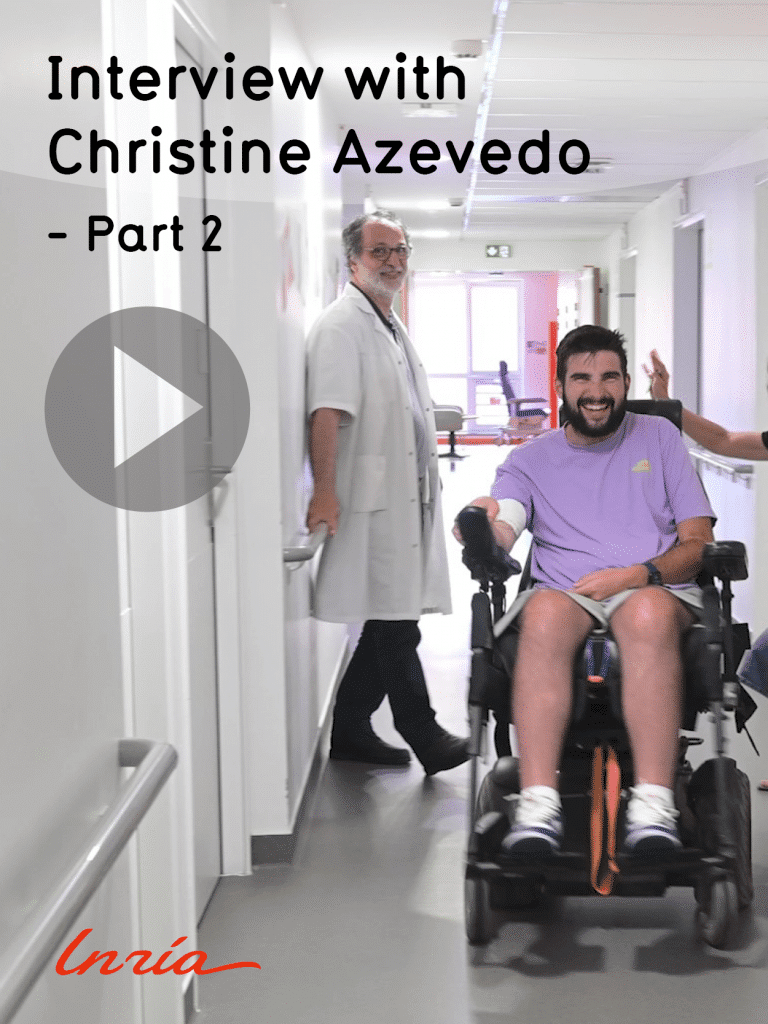
From Fishing Ropes to Self-Esteem

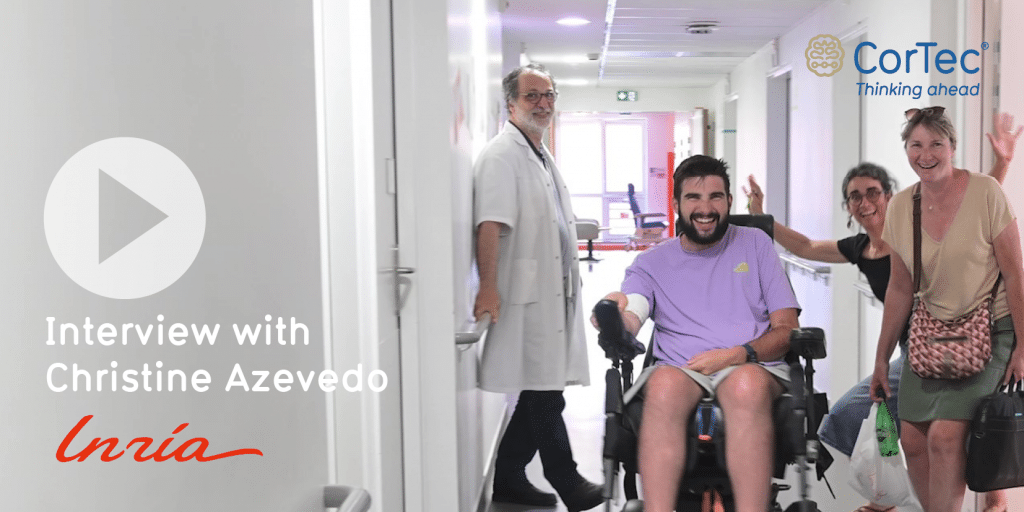
How the AI-Hand Project Puts Patients First – Interview with Christine Azevedo, Part 2

In the second part of our interview series, Christine Azevedo from Inria shares a deeply human perspective on the AI-Hand project – an ambitious initiative to restore hand and wrist movement for people with tetraplegia.

Christine begins by explaining the condition itself and the goal of the project: to help patients regain control over small but meaningful movements. These steps are built gradually, always with the patient’s personal goals in mind – until they’re happy with what the technology enables them to do.

One of the most touching examples she shares is about Maxime, a patient whose dream was to be able to fish again. The team built a custom setup with a fishing rope to help him achieve that goal. These kinds of tasks go far beyond technical challenges – they’re about restoring independence, dignity, and joy.

Christine also talks about the strong bonds formed with patients, who spend a lot of time with the research teams. Each patient brings a unique task, and each task brings new scientific insights that will help shape future solutions – not just for tetraplegia, but for other indications as well.

CorTec has been part of this journey from the beginning, providing cuff electrodes and working closely with the team to explore ideas and possibilities. It’s a long-standing collaboration built on trust, shared experience, and a common mission.

We thank Christine for this inspiring conversation – and all our partners in the AI-Hand project for their dedication to building neurotechnology that truly makes a difference.

More information about the AI-Hand Project can be found here: www.aihand.eu

Watch the full interview on youtube now!


Further readings in User Stories and Technology:

The Power of Active Implant Sytems

Active implant systems are the foundation of modern neurotechnology. It enables precise, bidirectional communication with...

Interview with Mariska van Steensel: Inside the INTENSE Project

Dr. Mariska van Steensel from University Medical Center Utrecht shares insights from the INTENSE Project,...

CorTec: Your Partner for Fully Integrated Neuromodulation & Medical Device Solutions 

Bringing a neuromodulation medical device to clinical reality is rarely just engineering. It is a...

Brain Interchange System Sets a New Standard

The recent publication in Nature Scientific Data by the research group around Takufumi Yanagisawa at...

Contact

Do you have any questions regarding our Company, our Products or our Technology?
We are happy to receive your message!

Get a Quote

We’re happy to help you realize your next project. Whether it is a complete implantable system design, an electrode or another component.

Please fill out the form below and our sales team will be in contact with you shortly.

SPECIFICATIONS

FEATURE 

Recording channels 

Sampling rate 

Sampling dynamic range 

High pass filter cut-off 

Low pass filter cut-off 

Amplifier band pass gain 

Band pass roll-off 

Reference


Stimulation 

Stimulation channels 

Current 

Current source 

Pulse width 

Power supply 

Wireless data transmission 

Closed Loop latency

VALUE

32 

1 kHz 

16 bit (74 nV smallest increment) 

ca. 2 Hz 

325 Hz 

Adjustable: 100-750 

20 dB/dec 

Any (subset) of the recording channels selectable by software or one dedicated hard-wired additional contact 

Current-controlled, biphasic, rectangular, asymmetric stimulus pulses (cathodic amplitude with pulse width followed by an anodic counter pulse of 1/4x amplitude and 4x pulse width) 

 32 

Max. -6 mA / +1.5 mA (24 µA increments) within

 compliance voltage range of -11 V to +5 V 

Can be directed to any of the 32 electrode contacts 

Negative phase: 10 µs – 2,500 µs

Wireless inductive, 120-140 kHz

Bi-directional, radio frequency in 2400-2483.5 MHz band ≤ 40 ms