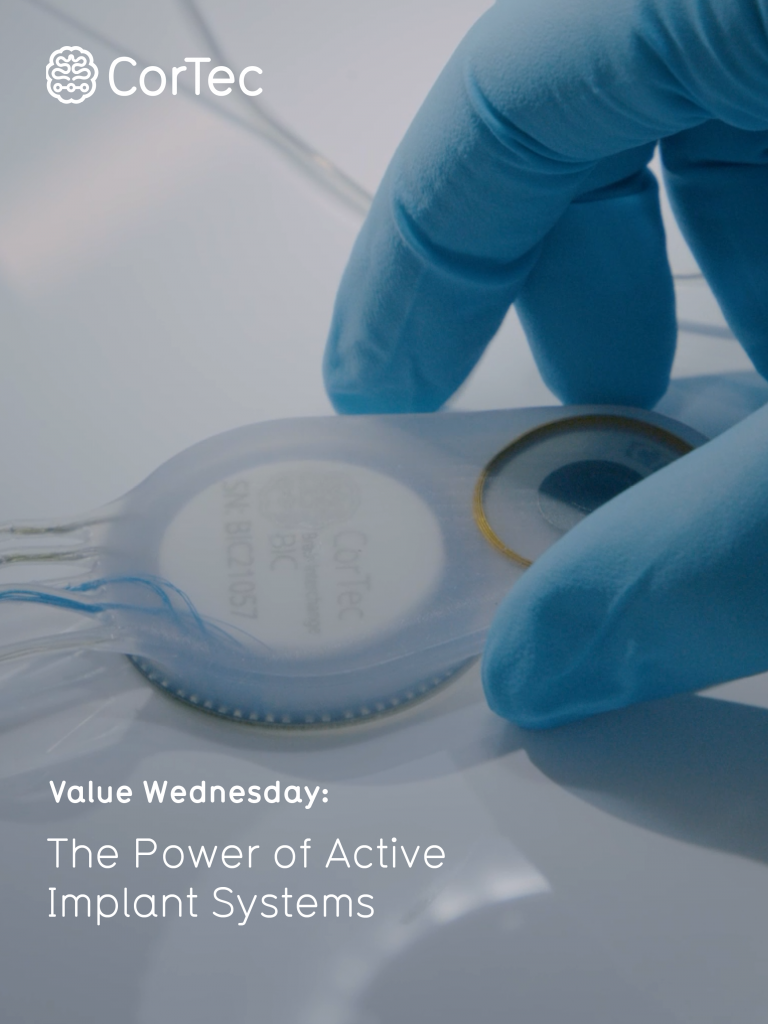
Active implant systems are the foundation of modern neurotechnology. It enables precise, bidirectional communication with the nervous system, driving powerful BCIs and Medical Devices in Neuromodulation, advancing therapy, research, and assistive technologies. Its impact on data quality, adaptability, and clinical effectiveness makes it a core technology in neurotech. Unlike isolated devices, integrated systems continuously interact with the nervous system, making treatments more precise, personalized, and effective.
At its core, active implant systems close the gap between diagnosis and therapy. Systems that record high-resolution neural activity, analyze it in real time, and react immediately enable closed-loop applications that adapt stimulation to the patient’s current neural state. Implants thus evolve into learning systems that support data-based therapy decisions and adapt to disease progression.
For conditions such as stroke, epilepsy, Parkinson’s disease, chronic pain, and inflammation, integrated neurotech systems offer new options when drugs reach their limits, aiming to improve outcomes, independence, and quality of life.
- Precise interface between brain and technology
Active implants not only record signals but also process and return them directly in the body. This ensures higher signal quality, lower latency, reduced interference, and stable long-term performance. In BCI’s, proximity to neural activity is key for precision and reliability.
- Bidirectional instead of just passive
Modern neurotech enables bidirectional communication: reading and stimulating neural activity in real time. Adaptive closed-loop systems respond dynamically to neural patterns, supporting personalized therapies for epilepsy, Parkinson’s, or chronic pain. The implant thus becomes an active therapeutic partner, not just a sensor.
- Scalability for future applications
Growing demands like more channels, higher data rates, smaller devices, and better energy efficiency, make active implant systems essential. Scalable electrodes, high-channel electronics, wireless transmission, and robust software allow active implantable systems to adapt across indications and clinical workflows, from preclinical to clinical use.
Why this matters now
Neurotechnology is advancing rapidly: BCIs become more practical, neuromodulation devices more precise, and active implants more personalized. Active implant systems enable these innovations to move from research into clinical application, shortening development cycles and accelerating translation into patient care.
How a company drives this forward
Turning breakthrough ideas into reliable neurotechnology requires more than components – it requires proven platforms, deep expertise, and end-to-end system development. At CorTec, we offer existing, ready-to-deploy technology platforms and bring together design, materials, leads, encapsulations, and testing to give our partners a fully coordinated pathway toward long‑term stability, biocompatibility, and regulatory readiness.
Our technologies are built to integrate seamlessly with customers’ hardware, software, and data architectures, enabling scalable production and shortening the route to clinically viable solutions. Central to this is our innovative closed-loop platform: a fully integrated intelligent implant solution that unites flexible electrodes, bidirectional communication, and onboard processing across up to 32 channels – scaling seamlessly to meet the demands of even the most complex neurotech applications.
Backed by an FDA masterfile, our platform significantly reduces regulatory burden from day one. By building on existing, proven technology, partners mitigate development risk and gain the speed to move quickly – from early proof-of-concept studies to full clinical trials – with immediate access to a ready-to-use device.
By partnering with CorTec, companies gain more than manufacturing capacity. As a neurotech solutions provider with proven, existing technology platforms, CorTec accelerates the path from concept to clinic – combining smart implant expertise, closed-loop platform capabilities, and deep systems expertise to turn ambitious neurotech concepts into safe, effective clinical products.