A breakthrough after a stroke

University of Washington and CorTec are working together to create new hope for stroke patients.


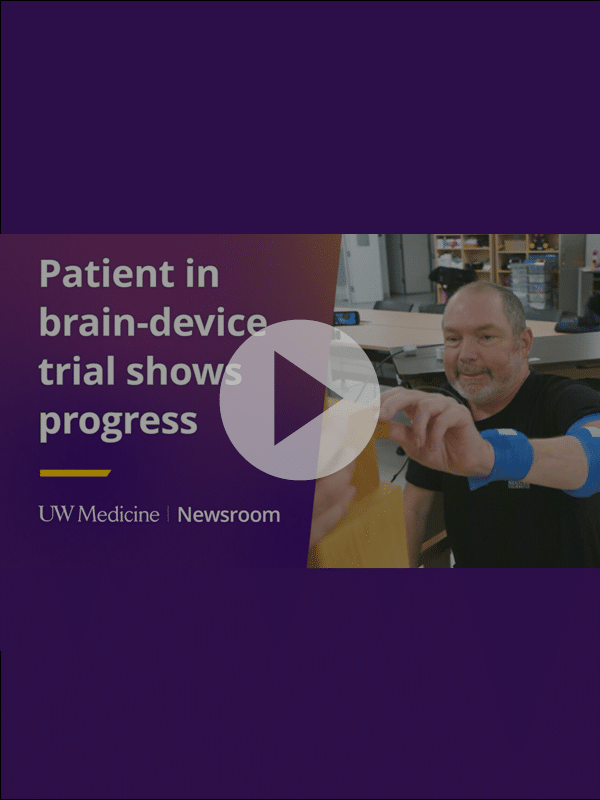
After two strokes, Matt Kidd’s left side was almost completely paralyzed. Years of therapy brought little progress, until he became part of a clinical trial at the University of Washington (UW). 

In this study, researchers are focusing on a novel brain implant developed in close collaboration with CorTec. Two thin silicone foils with electrodes were placed directly on the affected region of the brain. During rehabilitation, they emitted targeted electrical impulses designed to stimulate nerve cells to work together again and create new connections in the brain.

After just a few weeks, Matt was able to perform simple movements again – holding a cup, unscrewing a nut, closing the shower curtain. “I’m finding myself not even realizing I’m doing things [I couldn’t before],” he says.

For the doctors at UW, this progress is an encouraging sign. For CorTec, it is also proof that our technology can make a decisive contribution to opening up new perspectives for people after a stroke.

The research is still in its infancy, and more patients are being sought. But Matt’s story impressively demonstrates that when science and technology go hand in hand, dead ends can be overcome and paths back to life can be opened up.

You can read the full article here : https://newsroom.uw.edu/blog/in-brain-implant-study-patient-breaks-through-dead-end

Or watch the YouTube video: https://www.youtube.com/watch?v=P9sVMHyq3-E
Further readings in User Stories:

Interview with Mariska van Steensel: Inside the INTENSE Project

Dr. Mariska van Steensel from University Medical Center Utrecht shares insights from the INTENSE Project,...

CorTec: Your Partner for Fully Integrated Neuromodulation & Medical Device Solutions 

Bringing a neuromodulation medical device to clinical reality is rarely just engineering. It is a...

Brain Interchange System Sets a New Standard

The recent publication in Nature Scientific Data by the research group around Takufumi Yanagisawa at...

Precision in the Peripheral Nervous System

How imec is advancing bioelectronic medicine   The medicine of the future will increasingly rely...

Contact

Do you have any questions regarding our Company, our Products or our Technology?
We are happy to receive your message!

Get a Quote

We’re happy to help you realize your next project. Whether it is a complete implantable system design, an electrode or another component.

Please fill out the form below and our sales team will be in contact with you shortly.

SPECIFICATIONS

FEATURE 

Recording channels 

Sampling rate 

Sampling dynamic range 

High pass filter cut-off 

Low pass filter cut-off 

Amplifier band pass gain 

Band pass roll-off 

Reference


Stimulation 

Stimulation channels 

Current 

Current source 

Pulse width 

Power supply 

Wireless data transmission 

Closed Loop latency

VALUE

32 

1 kHz 

16 bit (74 nV smallest increment) 

ca. 2 Hz 

325 Hz 

Adjustable: 100-750 

20 dB/dec 

Any (subset) of the recording channels selectable by software or one dedicated hard-wired additional contact 

Current-controlled, biphasic, rectangular, asymmetric stimulus pulses (cathodic amplitude with pulse width followed by an anodic counter pulse of 1/4x amplitude and 4x pulse width) 

 32 

Max. -6 mA / +1.5 mA (24 µA increments) within

 compliance voltage range of -11 V to +5 V 

Can be directed to any of the 32 electrode contacts 

Negative phase: 10 µs – 2,500 µs

Wireless inductive, 120-140 kHz

Bi-directional, radio frequency in 2400-2483.5 MHz band ≤ 40 ms