Brain Interchange System Sets a New Standard

The recent publication in Nature Scientific Data by the research group around Takufumi Yanagisawa at The University of Osaka Graduate School of Medicine, marks a breakthrough for neurotechnology: long-term, high-quality electrocorticography (ECoG) data recorded wirelessly with CorTec’s fully implantable Brain Interchange ONE system.

What makes this achievement so significant? First, the BCI capability of our device. The Brain Interchange ONE is designed not only for passive data collection but for active, closed-loop applications—where neural signals are processed in real time to enable adaptive stimulation. This opens the door to advanced brain-computer interfaces for neurorehabilitation and future human augmentation.

Second, the ultra-long implantation period. The system demonstrated stable signal quality over many months without cables or restrictions on mobility. This is a critical step toward collecting chronic neural data under realistic conditions and training robust algorithms for next-generation BCIs.

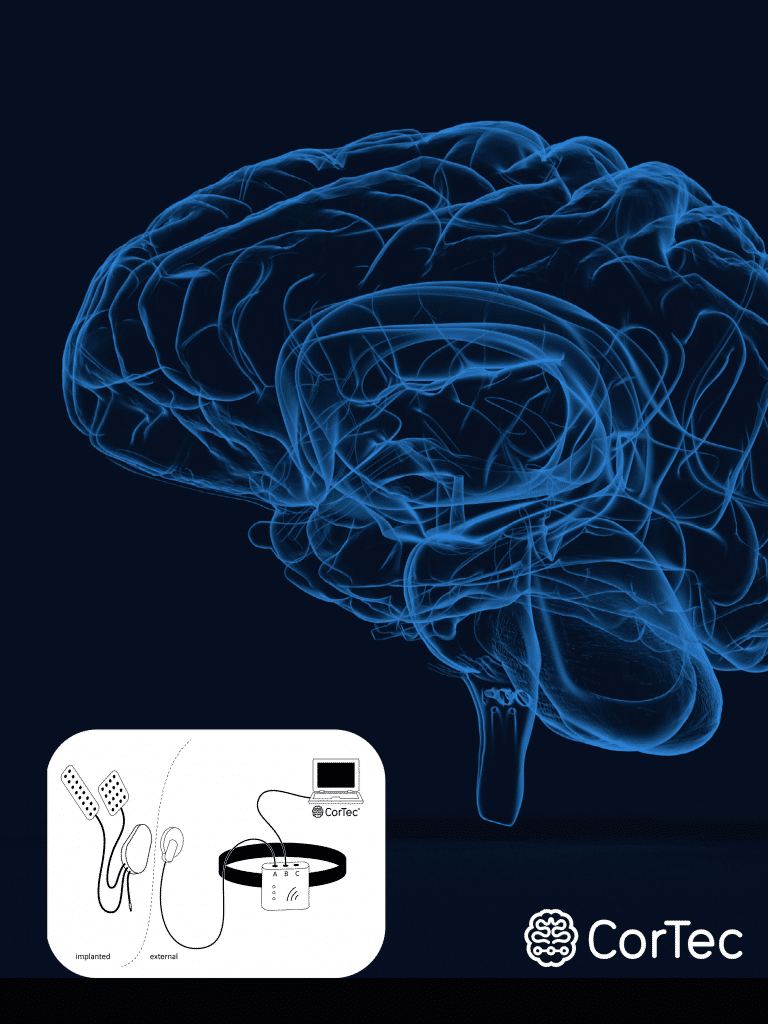
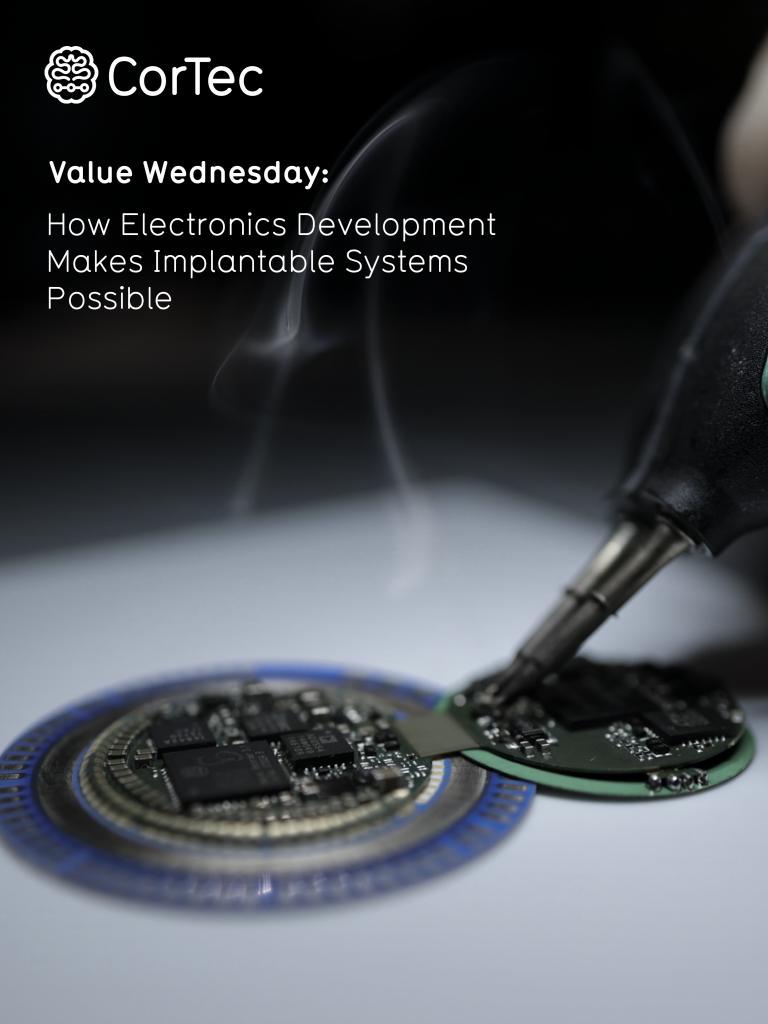
Technically, Brain Interchange ONE integrates two subdural ECoG arrays with 32 channels, a hermetically sealed electronics unit, and fully wireless power and data transmission. With a 1 kHz sampling rate and encrypted communication, it meets the highest standards for safety and data integrity—while enabling real-time processing for closed-loop neuromodulation.

The open-access dataset shared in the study accelerates global research and demonstrates that Cortec’s technology is not just a concept—it’s a proven platform for innovation in neuroscience and clinical translation.

Discover how Cortec is shaping the future of brain-computer interfaces and neurotherapeutic solutions.

Learn more about Brain Interchange System 

Read the full Publication in Nature Scientific Data 
Further readings in User Stories:

Interview with Mariska van Steensel: Inside the INTENSE Project

Dr. Mariska van Steensel from University Medical Center Utrecht shares insights from the INTENSE Project,...

CorTec: Your Partner for Fully Integrated Neuromodulation & Medical Device Solutions 

Bringing a neuromodulation medical device to clinical reality is rarely just engineering. It is a...

A breakthrough after a stroke

University of Washington and CorTec are working together to create new hope for stroke patients....

Precision in the Peripheral Nervous System

How imec is advancing bioelectronic medicine   The medicine of the future will increasingly rely...

Contact

Do you have any questions regarding our Company, our Products or our Technology?
We are happy to receive your message!

Get a Quote

We’re happy to help you realize your next project. Whether it is a complete implantable system design, an electrode or another component.

Please fill out the form below and our sales team will be in contact with you shortly.

SPECIFICATIONS

FEATURE 

Recording channels 

Sampling rate 

Sampling dynamic range 

High pass filter cut-off 

Low pass filter cut-off 

Amplifier band pass gain 

Band pass roll-off 

Reference


Stimulation 

Stimulation channels 

Current 

Current source 

Pulse width 

Power supply 

Wireless data transmission 

Closed Loop latency

VALUE

32 

1 kHz 

16 bit (74 nV smallest increment) 

ca. 2 Hz 

325 Hz 

Adjustable: 100-750 

20 dB/dec 

Any (subset) of the recording channels selectable by software or one dedicated hard-wired additional contact 

Current-controlled, biphasic, rectangular, asymmetric stimulus pulses (cathodic amplitude with pulse width followed by an anodic counter pulse of 1/4x amplitude and 4x pulse width) 

 32 

Max. -6 mA / +1.5 mA (24 µA increments) within

 compliance voltage range of -11 V to +5 V 

Can be directed to any of the 32 electrode contacts 

Negative phase: 10 µs – 2,500 µs

Wireless inductive, 120-140 kHz

Bi-directional, radio frequency in 2400-2483.5 MHz band ≤ 40 ms