Our urinary bladders have to fulfil two very different functions: On the one hand, they need to reliably collect urine throughout the day without any unintentional leakage. On the other hand, they need to empty as completely as possible during urination. To that end, the muscles involved in those two processes need to perform opposite actions. In the first process, they need to seal the urethra as tightly as possible and relax the bladder. In the second, they need to open the urethra and effectively contract the bladder.
Many people suffer from disorders of these functions. The consequences are incontinence and frequent urinary tract infections, which often cannot be adequately treated. Bioelectronic medicine has already identified peripheral nerves that control relevant sensorimotor functions (Previous Stories: Neuromodulation for Painful Bladders | Strengthening “weak bladders”). However, previous neurostimulation approaches have followed the classical approach of constant stimulation, which, not surprisingly in view of the cyclically changing requirements, has yielded limited success so far.
Warren Grill’s group at Duke University and Galvani Bioelectronics, UK, have now taken the next logical step. They applied different stimulation patterns during the filling versus the voiding phase. In two different animal models (rats and cats), the authors used CorTec °AirRay Micro Cuff electrodes to stimulate sensory and motor branches of the pudendal nerve, which, among other things, controls bladder function.
In order to hold back the urine better during the filling phase, inhibitory stimulation patterns proved to be effective. For efficient voiding, this inhibition had to be suspended or excitatory stimulating patterns had to be applied. An alternating combination of two different interventions yielded the best overall effects.
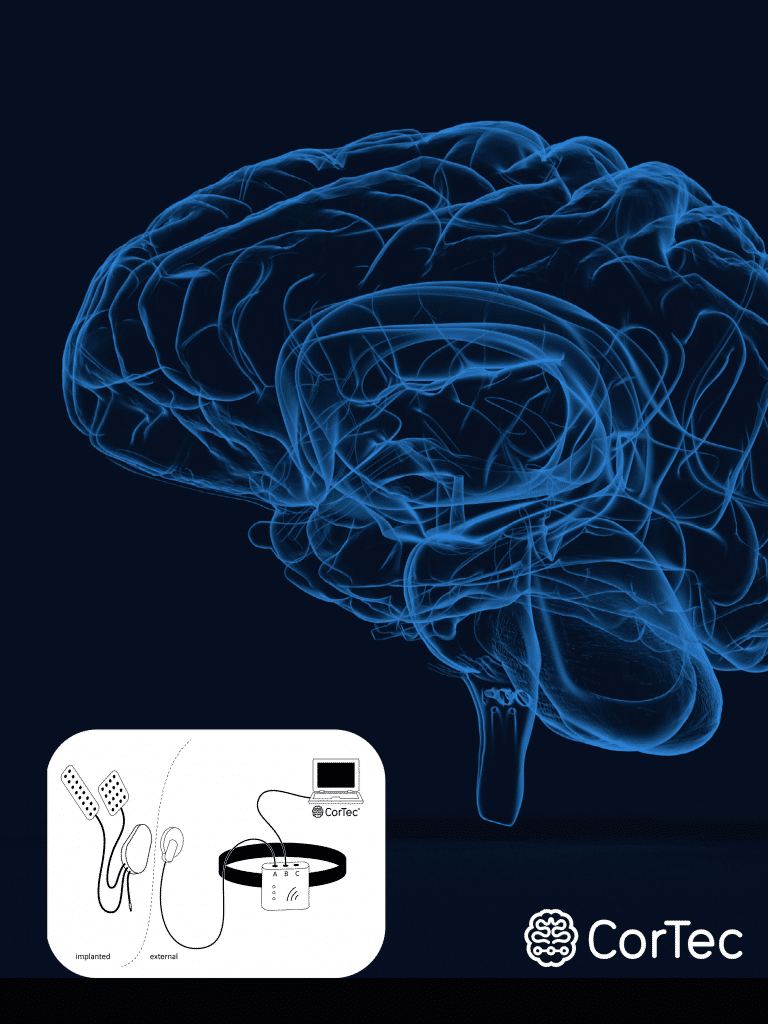
These findings reaffirm that optimal use of bioelectronic approaches requires the ability to flexibly adapt neuromodulation to the respective situation. Adaptive implant systems that can analyze the patient’s condition and adjust stimulation accordingly are needed to enable a so-called “closed-loop” control. With its Brain Interchange Implant System, CorTec is paving the way towards such intelligent adaptive systems.
Citation:
Hokanson JA, Langdale CL, Sridhar A, Milliken P, Grill WM. State-dependent bioelectronic interface to control bladder function. Sci Rep. 2021 Jan 11;11(1):314. doi: 10.1038/s41598-020-79493-7.