Miniaturizing implantable neurotechnology
Miniaturizing an implantable device is not a matter of choosing smaller parts. Final dimensions depend on how electronics, interconnects, power, packaging, thermal behavior, manufacturing, and implantation requirements fit together. The device must remain manufacturable, testable, and mechanically robust over its intended lifetime, so size reduction works best as a system-level task from the start.
Posted in Stories, on .
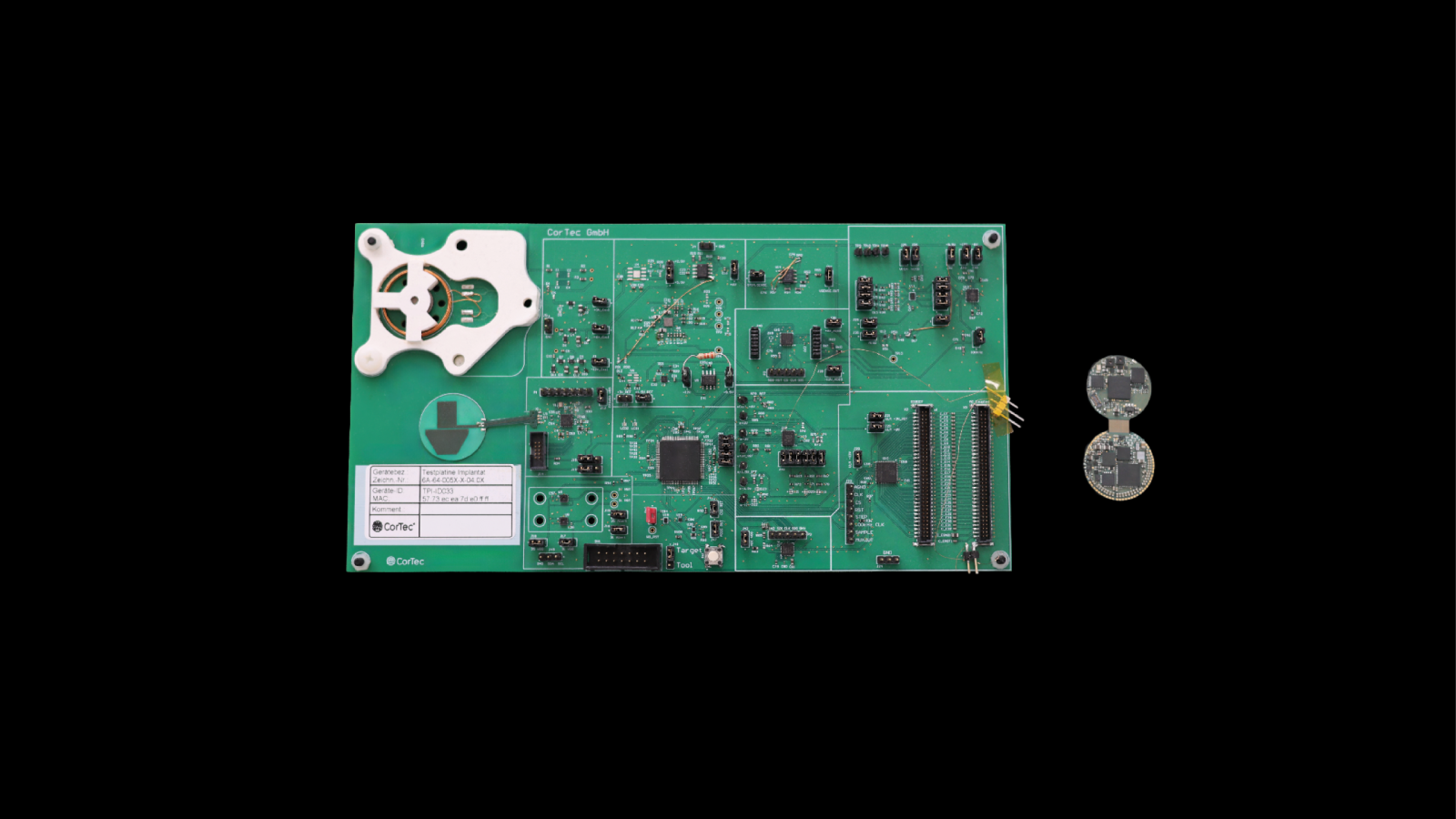
Reducing an implantable device’s size is not simply a matter of choosing smaller components or shrinking a printed circuit board. Final dimensions depend on how electronics, interconnects, power, packaging, thermal behavior, manufacturing, and implantation requirements fit together.
A compact design still needs to be manufacturable, testable, mechanically robust, and reliable over its intended lifetime. Miniaturization is therefore a system-level challenge.
Smaller components and board architecture
Small integrated-circuit packages, including DSBGA and other chip-scale packages, can reduce board footprint. Very small passive components, such as 01005 parts, can also make a circuit more compact. But smaller components can make assembly, inspection, and rework more demanding, and may make consistent manufacturing yield harder to achieve.
Rigid-flex PCBAs can fit electronics to an implant’s geometry and may reduce the need for connectors. Flex sections also need appropriate bend radii, strain relief, and protection against fatigue. Component placement and routing should support assembly and testing, not just the most compact theoretical layout.
Packaging, height, and feedthroughs
In some designs, thickness is more restrictive than planar area. Anatomy, surgical access, or insertion requirements can limit available height. Low-profile components and stacked layouts may help.
Feedthroughs can also set the scale of an implant. Conventional glass-to-metal feedthroughs may occupy significant space, particularly as channel count increases. Planar ceramic feedthroughs can support high-density electrical interfaces, but still need to meet requirements for hermeticity, insulation, strength, manufacturability, and long-term reliability.
The enclosure must meet relevant mechanical and impact-test requirements. Thinner ceramic or titanium walls can save space and mass, but may affect strength or sealing. Sharp edges and abrupt transitions can create stress concentrations or risk damaging surrounding tissue. Where appropriate, a soft, biocompatible covering such as silicone may improve tissue contact and reduce local pressure but adds to the implant size. Materials, seals, and exposed interfaces also need to remain stable in the body over the intended implant lifetime.
Power and battery considerations
A primary battery is the standard choice for many implants because it provides self-contained, long-term operation without requiring regular charging. Its feasibility, however, depends on keeping power consumption extremely low. For a given service life, every additional microampere increases the required battery capacity, and therefore the implant volume. The power budget should account for sensing, processing, telemetry, stimulation, and standby modes. As channel count increases, the associated electronics and data handling can also increase power demand, making efficient channel management essential.
A rechargeable battery may enable a smaller implant because it does not need to support operation for more than ten years without replenishment. This approach does, however, require an inductive charging coil and the associated charging circuitry. The coil must be accommodated within the implant, so the overall size benefit depends on the battery capacity saved compared with the space required for the charging system. The coil needs sufficient area and suitable geometry. A smaller coil may reduce implant size but can lower coupling efficiency or increase sensitivity to alignment.
Where minimizing thickness is the overriding goal, a battery-free concept may be attractive. Removing the battery can reduce package volume, but the implant then depends on externally supplied power, typically through an inductive link. The coil, power-transfer interface, and operating constraints must therefore be considered as part of the overall implant concept.
Evaluate the complete system
The smallest component or PCBA does not necessarily result in the smallest or most reliable implant. Feedthroughs, coils, batteries (dependent on power consumption), enclosure walls, connectors, handling features, and strain relief all contribute to final dimensions.
The useful design target is an implant that meets its size requirements while remaining practical to manufacture, integrate, test, power, and implant. Reaching that target requires system-level decisions early in development.
System-level design in practice
For customers, the challenge is to reduce size without creating problems elsewhere in the device. Choices about component density, board architecture, packaging, power, and assembly are connected. Considering those trade-offs early can help teams assess whether a compact design can also be built and tested as intended.
CorTec works with customers on engineering, prototyping, system integration, and manufacturing for implantable neurotechnology. In a miniaturization project, these activities can help connect design decisions with integration and manufacturing requirements as the system develops. CorTec’s Brain Interchange system uses a flat ceramic-feedthrough approach, providing one example of a packaging decision in an implantable system. The technical solution for each customer project depends on its specific requirements.
The goal is not miniaturization at any cost, but a design that balances size with practical development and manufacturing needs. To discuss your project, contact CorTec.