AI in medical data analysis and BCI development
Implantable Hardware Development (IHD) involves designing, engineering, and transferring to manufacturing the devices that are surgically placed inside the body to monitor physiological functions, deliver therapy, or restore lost capabilities. The scope is broad, and the work involved is highly specialized. Each component must function reliably inside the human body, under continuous mechanical and biochemical stress, often for years.
Posted in Stories, on .
From complex medical data to real-time insights
As medical data becomes increasingly important in healthcare, efficient processing is becoming equally critical. This is particularly relevant for high-density brain-computer interface systems, which can generate large volumes of data, potentially reaching gigabytes within a single hour.
While the current Brain Interchange system produces considerably less data, the underlying challenge remains the same: relevant neural information must be processed efficiently and distinguished from noise. In closed-loop BCI applications, neural activity may need to be interpreted and translated into a response within milliseconds.
Why medical data requires efficient processing
Medical data is often high-dimensional, multi-channel, and highly individual. It may contain biological signals, stimulation artefacts, electrical interference, and variations between users or recording sessions.
High data rates create challenges for storage, processing, and communication. These challenges increase when data must be analyzed continuously and locally rather than transferred to the cloud.
Real-time applications also require low latency. A BCI system may need to acquire a signal, decode relevant characteristics, classify the user’s intention, or detect disease-related biomarkers, and initiate a response within a short time.
Traditional statistical methods remain valuable for clearly defined questions and well-characterized datasets. However, they are generally designed to test predefined hypotheses rather than explore the full range of patterns in complex, high-dimensional data. In many cases, we do not yet know which relationships, features, or signals the data may reveal.
Signal processing methods can introduce further limitations. Mathematical filters and manually selected features can simplify analysis, but they may also remove relevant information if their assumptions do not match the signal. A diagnostic or behavioral feature may be lost before the data reaches the classifier.
From data complexity to AI-supported analysis
Artificial intelligence, machine learning, and deep learning can analyze large amounts of data across multiple channels and time points. These models can identify nonlinear relationships and combinations of factors that are difficult to define manually. They can also help explore patterns in data when the relevant features are not known in advance.
AI can support the analysis of less heavily preprocessed data. Instead of relying only on fixed filters and hand-crafted features, a model can learn which characteristics are relevant to a specific task. This may help preserve signal information during preprocessing.
Medical data often contains structured noise, including stimulation artefacts, changes in electrode contact, physiological interference, and electrical noise. With suitable training data, an AI model may learn to distinguish relevant signal components from unwanted patterns.
This approach requires careful validation. A model that removes noise may also remove relevant information if both patterns are similar. AI systems therefore need to be assessed through technical signal metrics and application-specific performance measures.
AI in brain-computer interfaces
EEG and ECoG signals are particularly challenging to analyze. They are noisy, high-dimensional, and different for each individual. Neural patterns may also change over time and between recording sessions.
Conventional feature engineering often captures only part of the available signal. AI models can learn patterns across multiple channels, frequencies, and time points. This may help identify subtle differences between neural events that are difficult to capture with hand-crafted features and classical classifiers.
Individual adaptation is another important consideration. A decoder trained with data from one person may not perform equally well for another. Traditional systems can require lengthy calibration sessions. Transfer learning and fine-tuning may help adapt a model to a new user or recording condition with less data.
Real-time processing at the edge
Real-time performance is essential, particularly in closed-loop BCI systems. Deploying AI models at the edge, close to the point of data acquisition and stimulation, can reduce latency by limiting the need to transfer data to external processing systems. This can support faster and more reliable communication between neural signals and the output device.
Local processing can also reduce the amount of data that needs to be transferred or stored externally. This can be relevant for systems that need to operate continuously, with limited bandwidth, power, or connectivity.
AI models for BCI applications must therefore be evaluated not only for accuracy, but also for computational efficiency, power consumption, latency, and reliable performance under changing conditions.
CorTec’s work with AI
CorTec is exploring AI-based solutions for processing brain data in real time. The objective is to bring relevant parts of the analysis closer to the point of data acquisition and reduce dependence on cloud-based processing.
Potential applications include decoding BCI signals with AI models running on local or mobile devices, including smartphones. CorTec is also investigating AI-based approaches for noise and artefact reduction.
Machine learning may support adaptive electrode selection. If an electrode is damaged or provides less reliable data, an algorithm could identify and prioritize the channels that currently contribute the most relevant information.
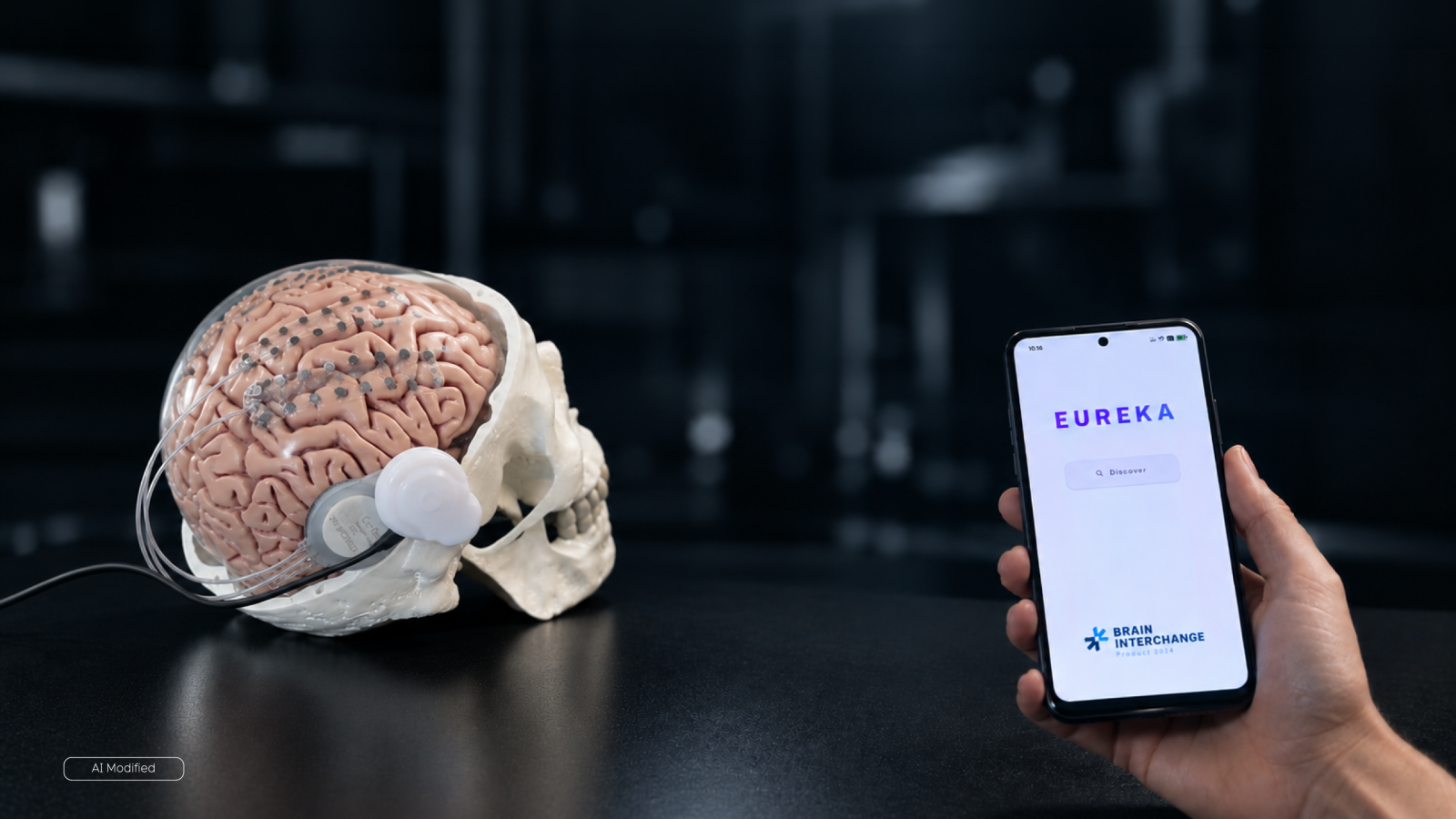
These principles have been explored in the Eureka app prototype, which demonstrates how neural data can be processed and translated into real-time system behavior. Further development and validation are required before such approaches can be considered for specific medical applications.
Engineering the complete system
AI is one part of a medical device system. Reliable performance also depends on the electrodes, electronics, software, data interfaces, power consumption, cybersecurity, and validation process.
For implantable neurotechnology, every component must be developed according to the requirements of the intended application. AI can support the interpretation of complex neural data and contribute to adaptive real-time systems. Its value depends on how well it performs as part of the complete device.
CorTec combines expertise in neural interfaces, electronics, software, and active implantable medical devices. Together with customers and research partners, CorTec works toward solutions that connect signal acquisition with reliable real-time processing.
For more information about the Eureka app prototype, watch this short video on LinkedIn: Watch the video.